An Analysis of Thai Marriage: Attitude and Behavior: A Case Study of Women in Bangkok Metropolis
Item
-
ชื่อเรื่องอื่น/ชื่อเรื่องเทียบเคียง
-
การวิเคราะห์ทัศนคติและพฤติกรรมการสมรสของสตรีไทย : ศึกษาเฉพาะกรณีของสตรีในเขตกรุงเทพมหานคร
-
คำอธิบายรายละเอียดของเอกสาร
-
Data available from 1947 to 1980 indicated that changes in marriage patterns had occurred in Thailand.* The trend toward increase in proportions of single and postponement of marriage in Thailand was similar to the situation found in many developing countries.7,15 Such changes were more obvious among males and females in the capital, Bangkok Metropolis. The highest average age at first marriage in 1980 was 25.9 years of age in Bangkok Metropolis, followed by 23.4 for the Central, 22.0 for the North, 21.9 for the South and 21.6 for the Northeast.
-
สรุปเนื้อหา/บทคัดย่อ
-
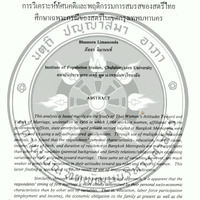
This analysis is based mainly on the Study of Thai Women's Attitudes Toward and Values of Marriage, undertaken in 1986 in which 1,004 working women, affiliated with the government offices, state enterprises and private sectors located in Bangkok Metropolis were interviewed by using a self-administered questionnaire. Through use of multiple classification analysis, it is found that the respondents' personal characteristics - education, marital status, income, place of birth, and duration of residence in Bangkok Metropolis are more significant than other set of variables (parental background and family relations/obligations) in explaining variations in their attitudes toward marriage. These same set of variables, however, are much weaker in predicting variations in their attitudes toward sex roles and status of women. This latter finding is speculated to be the result of use of inappropriate indicators.
Similarly, through use of Cox's partial likelihood approach, it is apparent that the respondents' timing of first marriage is more closely determined by their personal socio-economic characteristics than by other sets of variables. That is, education, labor force participation (employment and income), the economic obligation to the family at present as well as the positive attitudes toward being single are found to be the most significant predictors, andshow a negative relationship with marriage timing. Of the remaining variables: parental background shows no effect and sibling composition displays little effect on the timing of first marriage of the respondents.
These findings of effects of higher education, participation in the labor force, and higher income in delaying marriage carry policy implications regarding the delayea entrance into marriage and reduction of fertility. To increase age at first marriage, policies or programs concentrating on increasing non-familiar roles for women, or providing women with greater opportunities in participating social and economic activities should be emphasized and encouraged. All these would give women a new status and alternative socio-economic roles, rather than engaging solely in the traditional sex roles, i.e. being a wife and a mother too early in life. Moreover, the improvement of status of women in these areas would facilitate the integration of women into the development process more efficiently.
-
ผู้จัดพิมพ์/สำนักพิมพ์
-
National Research Council Thailand
-
วัน/เดือน/ปีที่ผลิตเอกสาร
-
1989
-
วันที่บันทึกข้อมูล
-
2025-05-31
-
สิทธิ์การเข้าถึง
-
This document is distributed under the terms of the Creative Commons Attribution 4.0 International (CC-BY-NC-ND 4.0) and copyright of the Chulachomklao Royal Military Academy
-
ขนาดหรือจำนวนของเอกสาร
-
31 leaves
Position: 3201 (53 views)